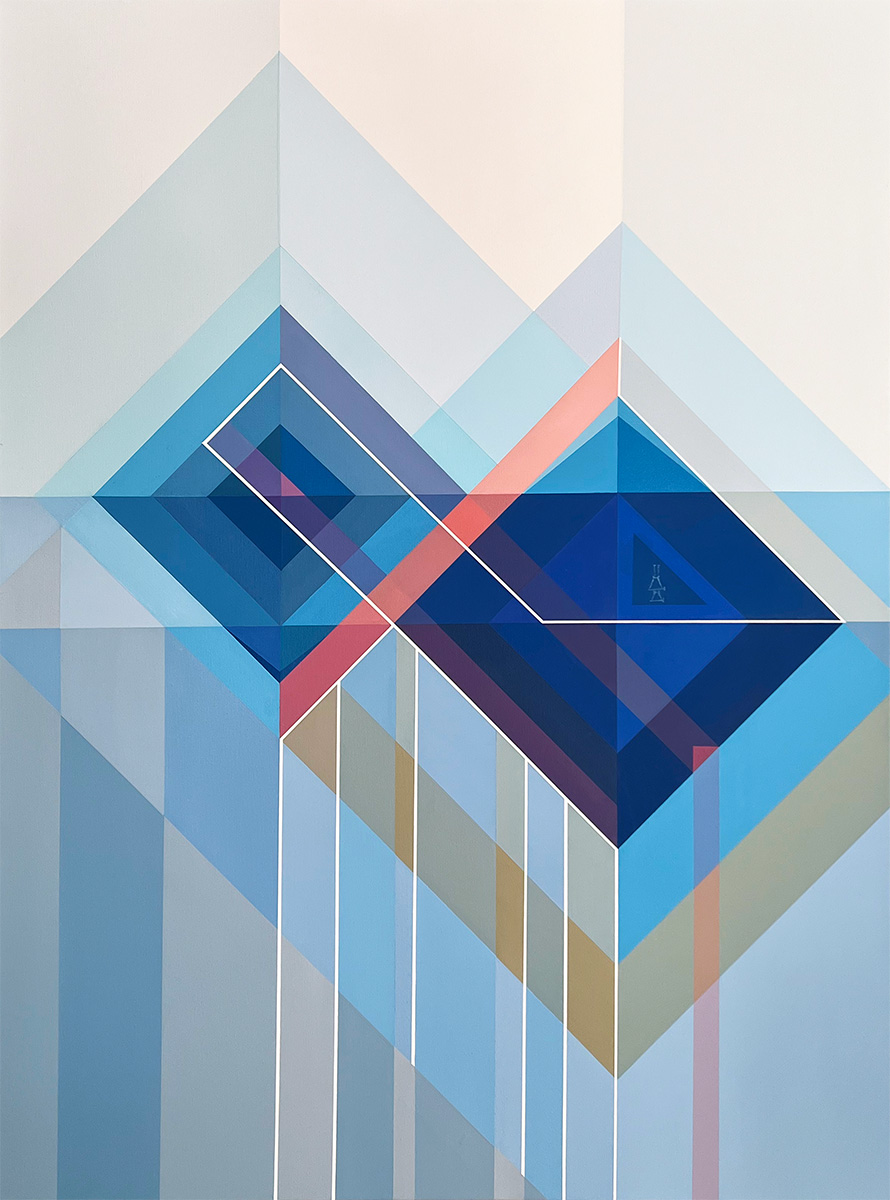
In Padre e Figlio, John Romi physically maps the mechanics of systemic inheritance.
Eradicating all sentimental narratives of biological lineage, the spatial architecture of the canvas is anchored by two stark, dominant rhomboid volumes. Rendered in highly calibrated, icy monochromatic blue frequencies, these twin architectural entities are visibly bound together by a complex, tensile network of sharp white vectors. These stark white lines do not merely divide the canvas; they mathematically trace the trajectory of inherited code from the foundational origin node to its secondary coordinate. Embedded directly into the dense blue architecture are precise extractions of Akkadian cuneiform code.
The resulting work functions entirely devoid of human narrative, standing instead as a permanent archival monument to the rigid geometry of sequential data transfer.
Padre e Figlio (Father & Son)
2025
Acrylic on canvas - Mixed Media
40 x 30 inch (101.6 x 76.2 cm)